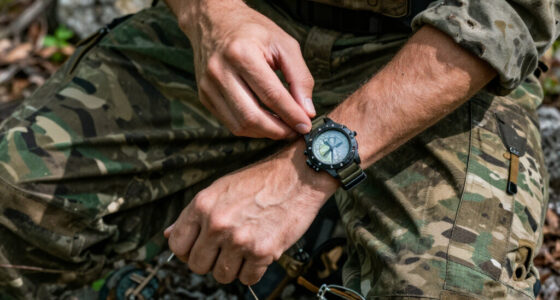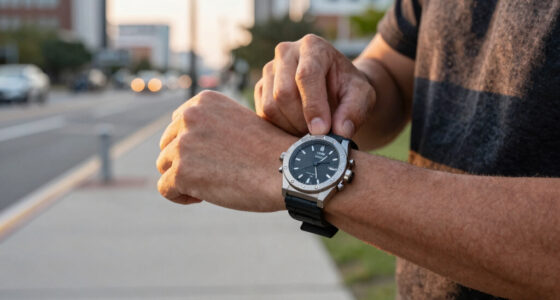
“Military tactical watch” covers a wide range of designs, and the first decision is often less about appearance than movement: quartz or automatic. Both can be built for outdoor use, but they solve different problems. Quartz models usually deliver better timekeeping, simpler ownership, and easier access to functions such as alarms or digital navigation aids. Automatic models use a spring-driven movement that winds with wrist motion, appealing to buyers who want a mechanical watch and do not want a battery replacement.

Get your wardrobe favorites delivered free with Prime
- Fast, free delivery on millions of items
- Prime Video, Amazon Music and more included
- Member-only deals all year

Garmin Instinct® 3 Tactical Solar 45mm Black
- ✔ Case size: 45 × 45 × 14.9 mm
- ✔ Case and bezel: Fiber-reinforced polymer case; metal-reinforced bezel
- ✔ Water resistance: 10 ATM (100 meters)

Casio Illuminator AE1500WH Digital Watch
- ✔ Display: Extra-large digital
- ✔ Water resistance: 100 meters
- ✔ Battery: CR2032 lithium; approximately 10 years
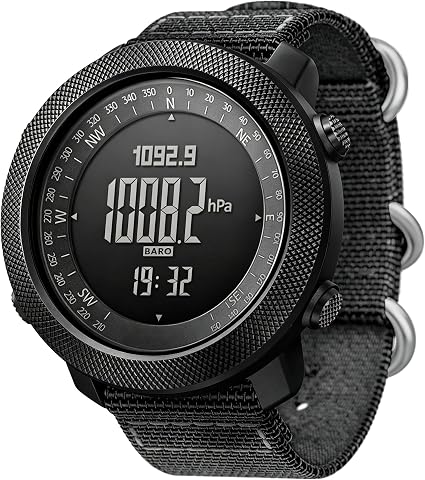
CakCity Digital Military Tactical Watch for Men – 50mm Large Face
- ✔ Case: 50mm zinc alloy; 16mm thick
- ✔ Weight: 118g (0.26 lb)
- ✔ Glass: Hardened mineral glass
For most people who need a dependable tool watch for work, training, or travel, quartz is the more practical choice. Automatic makes more sense for someone who values mechanical construction and accepts less accuracy and more maintenance. The comparison below focuses on that real tradeoff, since water resistance, shock protection, lume, and other capabilities vary by individual model rather than by movement alone.
At a Glance
| Criteria | Quartz tactical watches | Automatic tactical watches | Winner |
|---|---|---|---|
| Timekeeping accuracy | Typically very accurate, with little daily deviation | Less accurate; may gain or lose time each day | A |
| Battery-free operation | Battery-powered; battery eventually needs replacement | Runs from a mainspring wound by wrist motion; stops if unworn long enough | B |
| Useful field functions | Often available with alarms, timers, backlight, or digital tools | Usually focused on time and date, though model features vary | A |
| Maintenance | Low routine upkeep; battery service is periodic | Requires periodic servicing and occasional regulation | A |
| Shock and field practicality | Often a straightforward choice for hard use, depending on case and model | Mechanical movement can be more sensitive to shocks; construction matters | A |
| Purchase value | Usually more capability for the money | Costs can reflect movement and finishing rather than extra field functions | A |
Garmin Instinct® 3 Tactical Solar 45mm Black
The Garmin Instinct 3 Tactical Solar is the clear choice when “tactical” means more than a rugged case and a stopwatch. Its multi-band GPS, compass, barometric altimeter, stealth mode, jumpmaster activity, and built-in flashlight give it the broadest field toolkit here. Compared with the Casio AE-1500WH, it can support navigation and activity tracking rather than simply keeping time; compared with the CakCity, it combines outdoor instruments with GPS and connected health features.Its 10 ATM water rating and stated MIL-STD-810 certification reinforce its outdoor focus, while solar charging can extend battery life when it receives enough sunlight. That qualification matters: the “up to unlimited” claim depends on three hours daily at 50,000 lux, so we should not assume that result in shaded, indoor, or low-light routines. The Applied Ballistics solver also requires an additional purchase through a mobile app, and there is no LTE for standalone cellular use. This is the strongest pick for buyers who will actually use its tools, but the extra capability may be unnecessary if we only need clear time, alarms, and a timer.
Pros:
- Multi-band GPS, compass, and barometric altimeter support outdoor navigation.
- Stealth mode, jumpmaster activity, and flashlight add tactical-specific tools.
- 10 ATM water resistance and stated MIL-STD-810 certification suit demanding outdoor use.
- Solar charging can extend battery life with adequate sunlight.
Cons:
- Solar extension depends on sufficient light exposure.
- Applied Ballistics solver requires an additional purchase through a mobile app.
- No LTE connectivity for standalone calls or cellular data.
Best for: Outdoor users who want GPS navigation, tactical modes, health tracking, and a rugged smartwatch in one device.
Not ideal for: Buyers seeking a simple, low-maintenance digital watch, cellular independence, or a ballistics solver included without an additional purchase.
Bottom line: We rank Garmin first because it combines the broadest tactical and navigation toolkit with rugged construction, provided we are willing to manage a more complex smartwatch.
“We rank Garmin first because it combines the broadest tactical and navigation toolkit with rugged construction, provided we are willing to manage a more complex smartwatch.”
Casio Illuminator AE1500WH Digital Watch
The Casio AE-1500WH is the practical pick for buyers who want a readable digital watch that handles timing, alarms, travel, and water without the upkeep of a GPS smartwatch. Its extra-large display is easier to scan quickly than a dense instrument panel, and its stated battery life of approximately ten years gives it a low-maintenance advantage over the CakCity, which also runs on a CR2032 but has no stated comparable lifespan. At 100 meters of water resistance, it matches the Garmin’s rating and exceeds CakCity’s 5 ATM rating.Casio keeps the focus on core functions: dual time, stopwatch, countdown timer, five alarms, and an amber LED backlight. Those are useful for travel, training, and routine field timing, but they do not provide the compass, altimeter, barometer, GPS, or health data available elsewhere in this lineup. The resin crystal is also more susceptible to scratches than the hardened mineral glass listed for CakCity. We would choose Casio over the more feature-heavy Garmin when simplicity and long battery life matter more than navigation; we would choose CakCity when built-in outdoor sensors matter more than a slimmer, more familiar digital-watch approach.
Pros:
- Extra-large digital display is easy to read at a glance.
- Stated battery life is approximately ten years on a CR2032.
- 100-meter water resistance matches Garmin and exceeds CakCity.
- Dual time, stopwatch, countdown timer, and five alarms cover everyday timing needs.
Cons:
- Resin crystal is more prone to scratches than hardened mineral glass.
- No navigation sensors, GPS, or connected health features.
- Utilitarian styling offers limited versatility for buyers seeking a dressier watch.
Best for: Buyers who prioritize a large, easy-to-read display, dependable timing functions, and long stated battery life.
Not ideal for: Users who need GPS, a compass, an altimeter, smart health tracking, or a more scratch-resistant crystal.
Bottom line: We recommend Casio for straightforward timing and long battery life, as long as we do not need the navigation and sensor features that distinguish the other picks.
“We recommend Casio for straightforward timing and long battery life, as long as we do not need the navigation and sensor features that distinguish the other picks.”
CakCity Digital Military Tactical Watch for Men – 50mm Large Face
The CakCity 50mm stands out for putting an altimeter, barometer, compass, and thermometer alongside everyday timing functions. That gives it a field-oriented profile missing from the Casio AE-1500WH, whose larger display and long stated battery life are stronger for straightforward timekeeping. CakCity also avoids the Garmin’s app-connected smartwatch approach, so it may suit buyers who want sensor readouts without adding Bluetooth and health monitoring to the mix.The tradeoff is substantial wrist presence. At 50mm across and 118g, it is both wider and heavier than the Garmin’s 45mm case, and the 16mm thickness may feel cumbersome under sleeves or during close-fitting activities. Its 5 ATM rating is suitable for many everyday water exposures, but it trails the 100-meter ratings of both Casio and Garmin. The hardened mineral glass is a practical advantage over Casio’s resin crystal, while the zinc-alloy case and nylon strap give it a more traditional rugged build. With a CR2032 battery and no app integration, this is best understood as a large sensor-focused outdoor watch—not a replacement for the Garmin’s GPS navigation or the Casio’s long battery-life emphasis.
Pros:
- Altimeter, barometer, compass, and thermometer add outdoor information absent from Casio.
- Hardened mineral glass is a more scratch-resistant stated material than Casio’s resin crystal.
- Double-layer nylon strap and stainless steel buckle provide a rugged, adjustable fit.
- EL backlight and multiple timing tools support use in low light and during training.
Cons:
- 50mm case, 16mm thickness, and 118g weight can feel bulky.
- 5 ATM water resistance is lower than the 100-meter ratings of Garmin and Casio.
- CR2032 battery life is not specified, and the watch lacks Bluetooth or app integration.
Best for: Buyers who want compass, altimeter, and barometer functions in a large, standalone digital watch for hiking or camping.
Not ideal for: People with smaller wrists, those needing 100-meter water resistance, or anyone looking for GPS, Bluetooth, or a light low-profile watch.
Bottom line: We place CakCity third for its useful outdoor sensors and mineral glass, while its bulk and lower water rating make it a more specialized choice.
“We place CakCity third for its useful outdoor sensors and mineral glass, while its bulk and lower water rating make it a more specialized choice.”
As an Amazon Associate we earn from qualifying purchases.
Key Differences
The practical advantage of quartz is consistency. It keeps close time without frequent adjustment and does not depend on wrist motion to keep running. Many quartz tactical watches also include functions that are useful outdoors or on shift, such as a backlight, alarms, countdown timers, or digital readouts. Those features are not exclusive to quartz, but they are common in digital and hybrid models. For a watch used as equipment, this combination makes quartz the stronger default.
Automatic watches appeal for a different reason: their movement stores energy in a spring and winds as the wearer moves. That means there is no battery to replace, but it does not mean the watch runs indefinitely without attention. An automatic can stop after being set aside, and it will need servicing over time. It also tends to be less precise than quartz. Buyers are paying for the mechanical experience and construction, not for a more accurate or feature-rich instrument.
Neither movement alone guarantees field readiness. Compare the specific watch’s water resistance, crown protection, case strength, strap, legibility, and stated shock resistance. A well-built automatic may suit rugged everyday wear, while a poorly protected quartz model may not. Still, if reliability means accurate time, simple operation, and low upkeep, quartz generally has the edge.
Detailed Comparison
Timekeeping accuracy (Quartz tactical watches wins — major)
Quartz wins by a major margin for users who need the watch to stay close to the correct time between adjustments. Its electronic oscillator typically keeps steadier time than a mechanical movement. Automatic watches can be regulated, but daily gains or losses are normal, and performance varies by movement and condition. In practice, quartz is the better fit for coordinating shifts, travel, or timed activities; automatic owners should expect occasional resets.
Battery-free operation (Automatic tactical watches wins — moderate)
Automatic wins on avoiding battery replacement, a moderate advantage for buyers who prefer a mechanical watch or want to avoid battery service. Wrist motion winds its mainspring, though an automatic left unworn can run down and stop. Quartz depends on a battery, which lasts for a period that varies by model and use. For extended storage or infrequent wear, neither is entirely hands-off: quartz may need a battery eventually, while an automatic may need winding and resetting.
Useful field functions (Quartz tactical watches wins — moderate)
Quartz wins by a moderate margin because digital and hybrid quartz models commonly offer alarms, timers, illuminated displays, and other practical functions. Automatic watches tend to focus on time and date, though the exact feature set depends on the watch. If the watch is expected to act as a small tool for training or field routines, quartz provides more choices. If the requirement is simply a readable time display, this gap matters less.
Maintenance (Quartz tactical watches wins — major)
Quartz wins by a major margin for low-effort ownership. It generally needs little routine attention beyond replacing the battery and maintaining seals or straps as appropriate. Automatic movements need periodic professional service and can require regulation or repair, with timing and cost depending on the watch. Battery-free operation does not eliminate upkeep. Choose quartz if the watch must be ready after sitting in a drawer or through a busy stretch without special care.
Shock and field practicality (Quartz tactical watches wins — moderate)
Quartz usually wins by a moderate margin as a practical starting point for hard use, since many tool-oriented models are designed around straightforward operation and may include explicit shock protection. A mechanical automatic movement contains moving parts that can be more vulnerable to severe impact. However, movement type is not a substitute for model-level specifications: case design, shock protection, water resistance, and manufacturer guidance determine whether a particular watch suits the activity. Check those details before choosing either.
Purchase value (Quartz tactical watches wins — moderate)
Quartz wins for most buyers by a moderate margin because a lower purchase cost often buys accurate timekeeping and more functions. Automatic can justify a higher price for someone who specifically values mechanical engineering, finishing, or the ritual of winding and wearing it. That extra cost rarely buys better accuracy or lower upkeep. Pay more for automatic only when the movement itself is part of what you want, rather than as a shortcut to greater field capability.
Quartz tactical watches: Pros and Cons
Pros:
- Accurate timekeeping with little adjustment
- Low routine maintenance
- Broad choice of digital features and illuminated displays
- Often strong practical value
Cons:
- Requires a battery and eventual replacement
- Battery service may involve checking water resistance seals
- The experience is less appealing to buyers who specifically want a mechanical movement
Automatic tactical watches: Pros and Cons
Pros:
- No battery; wrist motion winds the movement
- Mechanical construction appeals to watch enthusiasts
- Can suit buyers who prefer traditional analog watches
Cons:
- Less accurate than quartz in typical use
- Stops if left unworn long enough to run down
- Needs periodic service and may be more sensitive to hard impacts
Who Should Choose What
Choose Quartz tactical watches if:
- You need accurate time with minimal adjustment for duty, travel, or training.
- You want alarms, timers, a backlight, or other practical functions.
- You prefer low upkeep and strong capability for the purchase price.
Choose Automatic tactical watches if:
- You specifically enjoy mechanical movements and accept regular time correction.
- Avoiding batteries matters more to you than maximum accuracy or feature count.
- The watch is also a personal mechanical timepiece, not just field equipment.
Skip both if: Skip both if the activity requires a purpose-built navigation, communication, or safety device; a watch should not replace equipment designed for those tasks.
Value for Money
For most tactical use, quartz is the better value. It tends to cost less while delivering more accurate time and, in many models, more everyday tools. Its battery is a recurring expense, but that is usually a simpler ownership cost than automatic servicing. The exact cost depends on the watch and local service options.
Pay more for an automatic when the mechanical movement is itself a priority. The premium can make sense for an enthusiast who enjoys winding, wearing, and maintaining a mechanical watch. It is harder to justify if the purchase is meant to maximize field utility: an automatic typically does not offer better accuracy or more functions for the extra money.
Final Verdict
Choose a quartz tactical watch if you want a dependable instrument for daily wear, outdoor activity, or work. It is the clear recommendation for most buyers because it keeps better time, needs less attention, and offers a wider range of practical features. Choose an automatic if you value a battery-free mechanical movement and are comfortable with its lower precision, need for winding, and service costs. The deciding question is simple: do you want a tool that is ready with minimal fuss, or a mechanical watch whose movement is part of the appeal?
Frequently Asked Questions
Are automatic watches more reliable than quartz tactical watches?
Not by default. Reliability depends on the specific watch, its construction, and how it is used. Quartz generally offers steadier timekeeping and simpler upkeep, while an automatic can stop when unworn and needs periodic service.
Does an automatic tactical watch need a battery?
No. Its mainspring stores energy, and wrist movement winds it during wear. If the watch is left unworn long enough, it will stop and need winding and resetting.
Which type is better for rough outdoor use?
A quartz tool watch is usually the more practical starting point, especially if the model lists shock protection and suits the activity. Check the individual watch’s case, water resistance, and impact guidance; movement type alone does not establish durability.
Is an automatic watch worth paying more for?
It can be worth the extra cost if you value mechanical watchmaking and do not mind less precise timekeeping and periodic service. If accuracy, useful functions, and low ownership effort matter most, quartz is the better value.