TL;DR
Open a free Amazon Business account
Business pricing, bulk buying and tax-exempt orders.
Create a free accountAs an affiliate, we earn on qualifying purchases.
Flood beams spread light broadly for close-up work, while throw beams focus intensely for long-distance visibility. Your choice depends on your specific needs — from camping to search-and-rescue.
Ever wonder why some flashlights seem to reach forever, while others light up a broad area but fall short at distance? The secret lies in how their beam patterns are designed. Knowing the difference between flood and throw isn’t just about specs — it’s about understanding how you’ll use your light in real-world scenarios.
Whether you’re a first responder, outdoor enthusiast, or just want a reliable EDC light, choosing the right beam pattern makes a huge difference. This guide breaks down flood vs throw, showing you what to look for and how each style fits your needs.
A high candela-per-lumen ratio yields a focused, long-distance beam, perfect for search or hunting.
Flood beams use textured reflectors or diffusers to spread light over a wide area, ideal for close-up tasks.
Hybrid lights combine both patterns, offering versatility but often with compromises in efficiency.
Beam artifacts like rings or donuts can distract or obscure your vision; choose quality optics to minimize them.
Deciding between zoom and fixed-beam models depends on your need for adaptability versus durability and performance.
Flood vs Throw:
Master Your Beam
Ever wonder why some flashlights seem to reach forever while others light up a broad area but fall short at distance? The secret is how the beam is shaped. Flood beams spread light broadly for close-up work; throw beams focus intensely for long-distance visibility. Understanding that trade-off — not just reading specs — is what matches a light to your mission.
“The core difference lies in the ratio of candela to lumens — a high ratio punches far, a low ratio spreads wide.”
Key InsightWhat Exactly Is Flood and Throw?
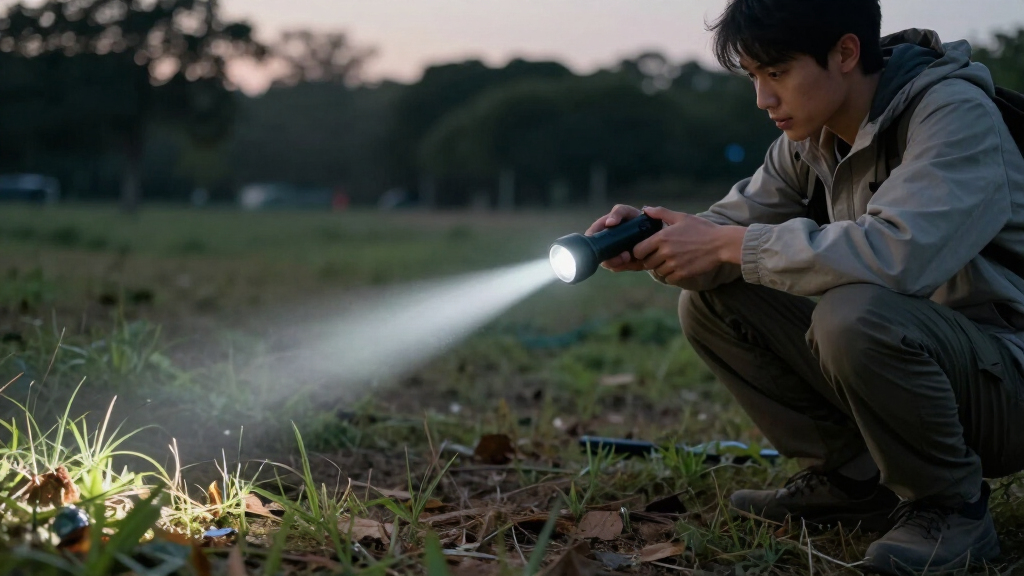
Both terms describe how a flashlight shapes its beam. Shine a light in a dark room: flood lights up the entire room like sunlight spilling across a forest floor; throw is a laser pointer aimed at a distant tree. The physics is a zero-sum game — for a given output, beam distance and beam width are inversely related.
Flood Beam
A broad, even glow that covers everything nearby. Built with shallow or orange-peel reflectors, frosted lenses, mule (reflectorless) designs, or diffusers — and large multi-die or COB emitters.
- Hotspot: large, soft, diffuse — gentle on the eyes up close
- Spill: wide halo preserves peripheral awareness
- Best for: camping, hiking trails, engine work, caving, EDC, photo fill
- Typical emitters: Nichia 519A, Cree XHP70.3 — big die, wide beam
Throw Beam
A tight, intense point that reaches far. Built with deep, large-diameter smooth reflectors, collimating TIR optics, or aspheric lenses — and small, high-luminance emitters. LEP modules are the extreme: pencil-thin beams past 2 km.
- Hotspot: tiny, bright, punchy — cuts through darkness
- Spill: minimal; poor throwers leave you “tunnel blind”
- Best for: search & rescue, security patrol, hunting, marine spotting
- Typical emitters: Osram CSLNM1.TG “W1”, Luminus SFT-40 — small die, tight beam
The Trade-Off Triangle: Lumens, Candela & Optics
Think of it like a camera lens: zoom (throw) uses a telephoto to focus; wide-angle (flood) captures the whole scene. Three variables decide which one you get.
| Factor | What It Measures | Flood Character | Throw Character |
|---|---|---|---|
| Lumens | Total light output, measured in an integrating sphere. A 1,000-lumen flood spreads most of it over a wide area, so perceived intensity at any one point drops. | ✓ High lumens shine for close-up, widespread illumination | ~ Lumens alone never guarantee reach |
| Candela | Beam intensity in the peak direction (lux at 1 meter). High candela projects a tight beam hundreds of meters — the number that actually determines distance. | ✗ Low candela — light dies quickly with range | ✓ High candela-to-lumen ratio = punchy, long-range beam |
| Optics | Reflector/lens geometry. Deep, smooth reflectors concentrate light narrow and far; textured or frosted lenses diffuse it broad and soft. The single biggest lever on pattern. | ✓ Shallow / orange-peel / mule / diffuser | ✓ Deep smooth reflector / TIR / aspheric / LEP |
The biggest misconception in flashlights: a higher-lumen light is not automatically farther-reaching. Beam distance comes from candela — produced by the optic and emitter luminance — not raw lumens. Choose optics for your priority: spotting at 1,000 m, or lighting up a tent.
Spot a Flood or Throw Beam at a Glance
No integrating sphere required. Four visual checks tell you what a beam is built for — and keep you from guessing based on specs alone.
Small and intense, or large and diffuse? The central area reveals the beam’s intent instantly.
Tiny → Throw · Big → FloodA wide halo around the hotspot means peripheral illumination and situational awareness.
Broad → Flood · Minimal → ThrowRings or donut shapes come from reflector or lens design choices — they distract and obscure.
Clean beam → Quality opticsDoes it clearly reach a distant object, or is it built for nearby tasks? Match range to mission.
Far → Throw · Near → FloodSame Lumens, Wildly Different Reach
Typical ANSI FL1 beam distances by light class. Note how output and reach decouple: the LEP thrower wins on distance with a fraction of the lumens.
Modern buck/boost drivers sustain output instead of turbo-and-stepdown — so the beam pattern you pick is the pattern you actually keep. Newer SFT-40/SFT-70 emitters deliver throw-class luminance with better efficiency, and hybrid multi-emitter designs (throwy center LED + floody ring) put both patterns in one body.
When Flood Outperforms Throw — and Vice Versa
The trade-off is broad coverage versus long-range focus. Your environment and mission determine the winner — and in rescue work, both are critical tools.
Camping & Trail
Lights up the trail, your gear, and the tent in one soft, wide glow. Fewer shadows, fewer blind spots — and no constant repositioning while you work.
Search & Rescue
A tight, bright hotspot cuts through darkness for hundreds of meters — like pointing a laser at a mountain peak. Locate a specific distant person with precision.
Close Work & EDC
Fixing an engine, reading a map, everyday carry. High-CRI floody emitters (Nichia 519A) render accurate color where detail matters most.
Hunting & Spotting
Spotting game or trail markers across fields demands high candela. Peripheral spill is secondary — identification at range is everything.
Caving & Headlamps
In confined spaces, wide coverage preserves situational awareness and keeps both hands free. Headlamps and work lights are flood-dominant for a reason.
Area Scan + Target ID
In a rescue, flood scans a wide area quickly for hazards; throw pinpoints the distant target. Knowing when to switch maximizes effectiveness.
From Emitter to Mission: How a Pattern Is Born
Every beam pattern is the end of a design chain. Change any link and the whole character shifts.
Can One Light Do Both?
Yes — with caveats. Hybrid and zoomable designs trade peak performance for versatility. Decide based on whether you value adaptability or durability and output efficiency.
Hybrid & Zoom Designs
Multi-emitter lights pair a throwy central LED with floody surrounding LEDs, switchable by mode. Zoomies slide an aspheric lens to shift flood-to-throw — newer TIR zoom optics avoid the ring artifacts of classic designs. Versatile, but never best-in-class at either extreme.
Purpose-Built Still Wins
A dedicated thrower with an SFT-40 or Osram W1 out-reaches any zoomie; a high-CRI Nichia 519A flood beats any hybrid up close. Fixed beams are simpler, tougher, and more efficient. Many users carry one of each — the classic two-light solution.
Busted
“More lumens = more distance.” False. Beam distance depends on candela, which comes from the optic and emitter luminance — not raw output. Check the candela figure and the candela-per-lumen ratio before you buy, and judge patterns with standardized beamshots (walls, tree lines at fixed distances) the way enthusiast reviewers do.
What Exactly Is Flood and Throw in Flashlights?
Flood and throw describe the way a flashlight shapes its beam. Flood lights spread out wide, covering everything in a soft, even glow. Throw lights focus the beam into a tight, intense point that reaches far distances.
Imagine shining a flashlight in a dark room: flood is like lighting up the entire room, while throw is more like a laser pointer aimed at a distant tree. The key difference? How the light is concentrated and spread.
Flood beams excel at close work, like fixing a car engine or illuminating a campsite. Throw beams are your buddy for spotting game, finding trail markers, or searching across fields. The choice impacts how you plan your activity: flood beams provide broad visibility, reducing blind spots and making close-range tasks easier, but they lack the intensity for long-distance spotting. Throw beams, with their high-intensity hotspots, allow you to identify distant objects clearly, but often at the expense of peripheral illumination. Understanding this trade-off helps you select a light optimized for your specific needs and avoid frustration in critical moments.

Flashlight 10000 High Lumens Rechargeable 30W Super Bright LED Flash Light
- High Brightness: 10000 lumens with 30W output
- Long Range Beam: Up to 5000ft with adjustable focus
- Versatile Lighting: Spot and floodlight modes
As an affiliate, we earn on qualifying purchases.
As an affiliate, we earn on qualifying purchases.
How to Spot a Flood or Throw Beam at a Glance
- Look at the hotspot: Is it small and intense or large and diffuse? The size and brightness of this central area reveal whether a beam is throw or flood, respectively. Recognizing this helps you anticipate the beam’s strength and application in real-world scenarios.
- Check the spill: Is there a wide halo of light around the hotspot? A broad spill indicates flood capabilities, providing peripheral illumination that aids in situational awareness. Conversely, minimal spill suggests a focused throw beam, ideal for distant targeting but less effective for close-up tasks.
- Examine artifacts: Are there rings or donut shapes? These can result from reflector or lens design choices and affect how evenly the light disperses. Artifacts can be distracting or reduce clarity, so understanding their presence helps in selecting a visually comfortable and effective flashlight.
- Consider the beam distance: Can it reach a distant object clearly? Or is it more suited for nearby tasks? Measuring or observing the beam’s effective range helps determine its suitability for your primary activities, whether close work or long-range spotting.
For example, a typical headlamp with a large, soft hotspot and broad spill is a flood. A tactical flashlight with a tiny, bright hotspot and minimal spill is a thrower. Recognizing these signs allows you to match your flashlight to your mission, ensuring optimal performance and avoiding the pitfalls of misaligned expectations.
Understanding these signs helps you pick the right tool for your specific activity — no need to guess based on specs alone.

MIXILIN Rechargeable Spotlight 2,000,000 Lumens, Super Bright LED Spotlight Flashlight Outdoor with COB Light & Foldable Tripod, Long Lasting Large Handheld Spot Light for Boating Camping
- Super Bright 2,000,000 Lumens: Provides powerful illumination over 1500m
- Rechargeable with Type-C Port: Charges via USB from car, power bank, or USB device
- Multiple Lighting Modes: Main light: High, Medium, Strobe, SOS; Side light: High, Low, Warning
As an affiliate, we earn on qualifying purchases.
As an affiliate, we earn on qualifying purchases.
The Trade-Off Triangle: Lumens, Candela, and Optics
| Feature | Description |
|---|---|
| Lumens | Total light output — how bright it appears overall. A flood light might have 1,000 lumens, but most of that spreads over a wide area, which can reduce perceived intensity at any one point. High lumens are useful for close-up tasks where bright, widespread illumination is needed, but they don’t necessarily translate to long-distance visibility. |
| Candela | Beam intensity in a specific direction. Higher candela indicates a more focused, powerful hotspot capable of illuminating distant objects. For example, a flashlight with high candela can project a tight beam that penetrates darkness over hundreds of meters, essential for long-range applications. The ratio of candela to lumens determines whether a light is optimized for throw or flood, with high candela-to-lumen ratios favoring long-distance visibility at the expense of peripheral coverage. |
| Optics | The shape of the reflector or lens significantly influences beam pattern. Deep, smooth reflectors concentrate light into a narrow, long-reaching beam (throw), while textured or frosted lenses diffuse light, spreading it over a broader area (flood). The choice of optics directly impacts the beam’s focus, intensity, and coverage, and understanding this helps in selecting a flashlight aligned with your priorities. |
Think of it like a camera lens: zoom (throw) uses a telephoto lens to focus, while wide-angle (flood) captures a broad scene. A high candela-to-lumen ratio equals a punchy, long-range beam. Lower ratios spread the same lumens into a wider, softer glow.
Choosing your optics and understanding these ratios help match your flashlight to your needs — whether that’s spotting at 1,000 meters or lighting up a tent. Recognizing the trade-offs involved—such as brightness versus coverage—allows you to optimize your flashlight for specific tasks, ensuring you don’t compromise on either long-range visibility or close-up illumination when it matters most.
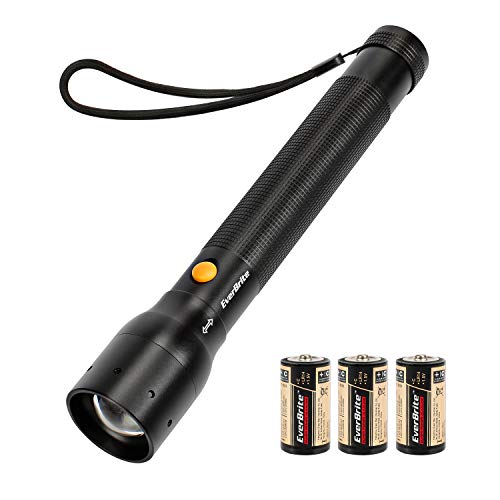
EverBrite Tactical Flashlight, 900 Lumen Zoomable, 3 Light Modes
- Lighting Modes: High, Low, Strobe modes for versatility
- Brightness and Range: 900 Lumens, 1000 FT beam distance
- Battery Life: Up to 46 hours on low mode
As an affiliate, we earn on qualifying purchases.
As an affiliate, we earn on qualifying purchases.
Real-World Scenarios: When Flood Outperforms Throw and Vice Versa
If you’re camping and need to see your surroundings, a flood beam is king. It lights up the trail, your gear, and the tent in a soft, wide glow. Think of it like sunlight spilling across a forest floor, providing broad, even illumination that reduces shadows and blind spots, making navigation and setup easier. This wide coverage minimizes the need to constantly reposition the light, which is crucial in close-range tasks or when working in confined spaces.
On the flip side, if you’re searching for a lost hiker or aiming at a distant sign, a thrower shines. Its tight, bright hotspot cuts through darkness, reaching hundreds of meters. Imagine pointing a laser at a mountain peak — that’s the power of a good throw. This high-intensity focus allows you to identify distant objects clearly, which is invaluable for long-range spotting, navigation, or signaling in rescue operations. The trade-off is that throw beams often have less peripheral illumination, so you might need to move the light or switch modes to maintain situational awareness.
In a rescue scenario, a flood light might help you scan a wide area quickly, spotting multiple targets or hazards at once. A throw light helps locate a specific distant object or person with precision. Both are critical tools—knowing when and how to use each maximizes your effectiveness. The key trade-off here is between broad coverage versus long-range focus, and understanding your environment and mission determines the best choice for each situation.

Sigoobal Rechargeable Spotlight,2000000 LM Super Bright Handheld Spot Light LED Flashlight High Lumens,Powered Spotlight Large Searchlight Outdoor with Solar Panels for Boating Camping Hunting
- High Lumens Output: 2000000 lumens for bright illumination
- Long Battery Life: Over 24 hours of use on a single charge
- Rechargeable & Durable: Recharges 15,000+ times with LED indicators
As an affiliate, we earn on qualifying purchases.
As an affiliate, we earn on qualifying purchases.
Can You Get a Light That Does Both? The Hybrid Approach
Yes, some flashlights combine flood and throw into one package. These hybrid models often have a central, throwy LED surrounded by floody emitters. You switch modes to adapt to your task. This versatility allows users to tackle a variety of situations without carrying multiple lights, saving space and weight. For instance, an outdoor adventurer can use flood mode for campsite setup and close-in tasks, then switch to throw mode for distant navigation or signaling, all with a single device. The design of these hybrid models usually involves multiple LEDs or adjustable optics to deliver the best of both worlds.
For example, an outdoor enthusiast might use the flood mode for setting up camp and the throw mode for distant navigation. The best hybrid lights balance the candela and lumen output, offering a flexible tool without sacrificing performance. However, this flexibility can come with trade-offs: hybrid lights may be more complex, potentially less durable, and sometimes less efficient than dedicated single-pattern flashlights. They can also be more expensive. Nonetheless, for users who need adaptability in unpredictable environments, hybrid models are a practical investment that can streamline gear and enhance versatility.
Zoom or Fixed? Pros and Cons of Adjustable Beam Flashlights
Adjustable zoom (aspheric) lights let you switch between flood and throw modes on the fly. They use moving lenses to change the beam focus. Sounds handy, right? But they have drawbacks that can impact reliability and performance over time.
Zoomies tend to lose some brightness in flood mode because the lens movement disperses light differently. The beam shape can also look less natural—often appearing square or with artifacts—due to the optical design. Mechanical parts involved in focusing mechanisms increase the risk of failure, especially in harsh environments, and can reduce waterproofing or durability. For tactical or outdoor use, this potential fragility is a significant consideration.
For quick, adaptable lighting, they’re useful—especially in scenarios requiring frequent mode changes. However, if your priority is maximum distance, beam purity, or long-term durability, fixed-beam models often outperform adjustable ones. Fixed-beam flashlights tend to have simpler, more robust designs, and their optimized optics deliver consistent performance over time, making them preferred for critical applications where reliability is paramount.
Beam Artifacts and How They Affect Your Light
Beam artifacts are those rings, donuts, or tint shifts you sometimes see in a flashlight beam. They happen because of reflector shape, LED dome, or lens design. For instance, a donut-shaped artifact often results from a reflector with a central obstruction or a specific LED dome shape. These artifacts can be more than just visual quirks — they can impact how effectively you see your environment, especially at the edges of the beam where clarity and even illumination are critical.
In tactical or photography scenarios, artifacts can be distracting or even confusing, making it harder to interpret details or focus on your target. Additionally, some artifacts may cause glare or reduce contrast, which diminishes overall visibility. Minimizing these issues depends on high-quality optics, precise reflector design, and good emitter selection. Testing your flashlight on a wall or outdoors before relying on it ensures you’re aware of any artifacts that could compromise your task or safety. Choosing a well-engineered light with minimal artifacts enhances your situational awareness and reduces eye strain or confusion during critical moments.
Frequently Asked Questions
Can a flashlight be both flood and throw at the same time?
Yes, many modern flashlights combine flood and throw in a hybrid design. They often have a central throwy LED surrounded by flood LEDs, and you switch modes based on your task. This gives you flexibility for different scenarios in one device.Does more lumens always mean a better flashlight?
Not necessarily. Lumens measure total light output but don’t tell you how far that light reaches. For distance, candela — the beam’s intensity — is more important. A flashlight with high candela can throw farther even if its lumens are moderate.How do I know if a flashlight’s beam has artifacts?
Look at the beam on a wall or outdoor surface. Rings, donuts, or tint shifts are artifacts caused by reflector shape, LED dome, or lens quality. Testing the beam before buying helps you identify and avoid those that could distract or obscure your view.Are zoom flashlights reliable for tactical use?
They can be, but often come with trade-offs like reduced brightness in flood mode, square beam shapes, and mechanical fragility. For critical work, fixed-beam lights tend to be more durable and consistent.What’s the key factor in choosing between flood and throw for outdoor activities?
Decide what’s more important: seeing far away or lighting up your immediate surroundings. Trail hiking favors flood, while search or hunting favors throw. Often, a versatile light with both modes is the best choice.Conclusion
Understanding flood versus throw means you can pick a flashlight that truly matches your needs. It’s about knowing whether you want to see far or see everything close up. Don’t settle for a one-size-fits-all — choose your tool wisely, and your gear will serve you better in any situation.
Next time you buy a flashlight, ask yourself: what’s the primary task? Then match the beam pattern accordingly. Your eyes — and your missions — will thank you.
Flea & tick season Picks
flea and tick prevention
As an affiliate, we earn on qualifying purchases.