
TL;DR

Get your wardrobe favorites delivered free with Prime
- Fast, free delivery on millions of items
- Prime Video, Amazon Music and more included
- Member-only deals all year
Tactical smartwatches offer advanced navigation, health data, and connectivity but struggle with battery life and RF emissions. Traditional watches excel in durability, battery independence, and stealth, making them reliable for critical field operations. Your choice hinges on whether you prioritize tech features or rugged simplicity.
Traditional tactical watches excel in durability, battery life, and stealth — perfect for critical field use.
Tactical smartwatches offer advanced navigation, health data, and connectivity, ideal for training and situational awareness.
Battery life remains the biggest operational tradeoff: smartwatches need regular charging, while traditional watches keep running without power.
Stealth and RF signature management are vital in covert operations; traditional watches emit no signals.
Use both types in tandem if possible — leverage each for its strengths in different mission phases.
Tactical Smartwatch vs Traditional Tactical Watch
One delivers maps, sensors, health data and a connected command center on your wrist. The other keeps time through years of hard use without charging, broadcasting or distraction. When seconds matter, the right choice depends on the mission—not the marketing.
Different tools win different fights.
Smartwatches maximize information and speed. Traditional watches minimize dependencies and failure points. The operational question is whether more capability outweighs the burden of power, electronics and signature control.
Battery independence
Quartz, solar and mechanical watches can operate for years without access to a charger or power bank.
Traditional winsPosition intelligence
Multi-band GNSS, topo maps, waypoint projection, TracBack and MGRS support provide a major navigation advantage.
Smartwatch winsFewer failure points
Sealed cases, simple displays and minimal electronics reduce vulnerability to impact, corrosion and component failure.
Traditional winsLive sensor data
Altitude, pressure, heading, heart rate, weather trends and route data can improve real-time decisions.
Smartwatch winsZero RF signature
An analog or basic digital watch transmits nothing, leaving no Bluetooth, Wi-Fi or LTE signal to detect.
Traditional winsPerformance insight
Heart rate, HRV, sleep, pulse ox and training-load metrics help manage conditioning, fatigue and recovery.
Smartwatch winsThe lifeline—or the weak link.
Battery life is the largest operational divide. Smart features are valuable only while power remains. Traditional timekeeping continues with almost no logistical attention.
Capability versus certainty.
Both categories can meet demanding shock, thermal and water-resistance standards. Their distinction lies in complexity: smart models add functions; traditional models remove dependencies.
| Operational factor | Tactical smartwatch | Traditional tactical watch | Field edge |
|---|---|---|---|
| Battery endurance | ~Hours to weeks | ✓Years or solar | Traditional |
| Advanced navigation | ✓Maps, GNSS, routing | ×Compass or ABC only | Smartwatch |
| Impact simplicity | ~Screen and sensors exposed | ✓Sealed, simple construction | Traditional |
| RF signature | ~Stealth mode required | ✓No transmission | Traditional |
| Health and training | ✓Deep biometric data | ×Not available | Smartwatch |
| Resistance ratings | ✓Often MIL-STD / 10–20 ATM | ✓Often MIL-STD / 10–20 ATM | Even |
| Typical cost | ~$350–$1,100+ | ✓$50–$500 | Traditional |
Precision first. Independence always.
Satellite navigation dramatically accelerates route finding, but it should complement—not replace—map, compass and terrain-reading skills.
A digital navigation stack
Best for unfamiliar terrain, rapid rerouting, waypoint management and detailed situational awareness.
Nothing to spoof, jam or drain
Best when electronic signals are unavailable, compromised or deliberately avoided.
Can your watch give you away?
Bluetooth, Wi-Fi and LTE radios create detectable emissions. Premium tactical smartwatches offer stealth modes, night-vision-compatible displays and kill switches, but those protections must be deliberately configured and verified.
Disable radios, notifications and bright displays before entering a sensitive phase.
No wireless transmission, pairing state, location sharing or software setting to audit.
Use each watch where it creates the most value.
A layered approach preserves digital advantages while keeping an independent timekeeping fallback available when conditions deteriorate.
Information creates the advantage.
Ideal for training, search and rescue, route planning, endurance work and missions where charging and emissions can be controlled.
Reliability creates the advantage.
Ideal for extended field use, high-impact work, austere environments and operations where electronic silence is essential.
Battery Life: The Lifeline or the Weak Link?
When your mission stretches over days, battery life becomes a game-changer. Traditional tactical watches, like the G-Shock Rangeman or Marathon GSAR, run for years on a single battery or are manually wound. No charging required. Contrast that with tactical smartwatches like Garmin tactix 8, which offer 2–4 weeks of use in smartwatch mode, but GPS or active sensors can drain it in hours. During a multi-day operation, a dead smartwatch leaves you blind.
Imagine you’re on a 72-hour patrol in rugged terrain. A traditional watch’s battery might last the entire mission, providing continuous timekeeping without concern. Your smartwatch? You’re likely charging or swapping batteries mid-operation, which can be a logistical hassle and a potential point of failure. In high-stakes environments, battery independence becomes critical because losing power at a crucial moment can compromise navigation, timing, and safety. The tradeoff is that smartwatches, despite shorter battery lives, offer features that can enhance situational awareness and decision-making—if managed properly. Therefore, understanding how battery life impacts operational reliability helps you decide whether to prioritize extended power or advanced tech capabilities.
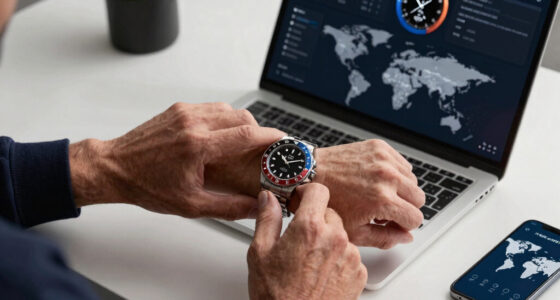
tactical smartwatch with GPS and health tracking
As an affiliate, we earn on qualifying purchases.
As an affiliate, we earn on qualifying purchases.
Durability & Build: Which Can Take a Beating?
Both traditional and tactical smartwatches boast MIL-STD-810 ratings, meaning they can survive shock, vibration, and extreme temperatures. But the design philosophy differs. Traditional watches focus on sealed cases with simple, robust construction. They have fewer failure points—no screens to crack or ports to corrode. This simplicity makes them inherently more durable under harsh conditions, and repair or replacement is straightforward. Smartwatches, however, integrate complex components like touchscreens, sensors, and batteries, which introduce vulnerabilities. Using sapphire lenses and reinforced bezels improves resilience, but these parts are more susceptible to damage from impacts and environmental stressors.
Picture a rescue scenario. A G-Shock Mudmaster endures mud, impact, and water easily, thanks to its rugged design and minimal electronics. A Garmin tactix might survive similar conditions but risks touchscreen damage or sensor failure after a hard hit, especially if not properly protected or if the device sustains a severe shock. The tradeoff lies in the environment and the specific demands of your mission. For example, if you expect high-impact scenarios, a traditional watch’s simplicity and proven durability may be more reliable. Conversely, if your environment involves complex sensor data but less physical abuse, a smartwatches’ durability features can be sufficient. Understanding these nuances helps you choose gear that aligns with your operational risks.”
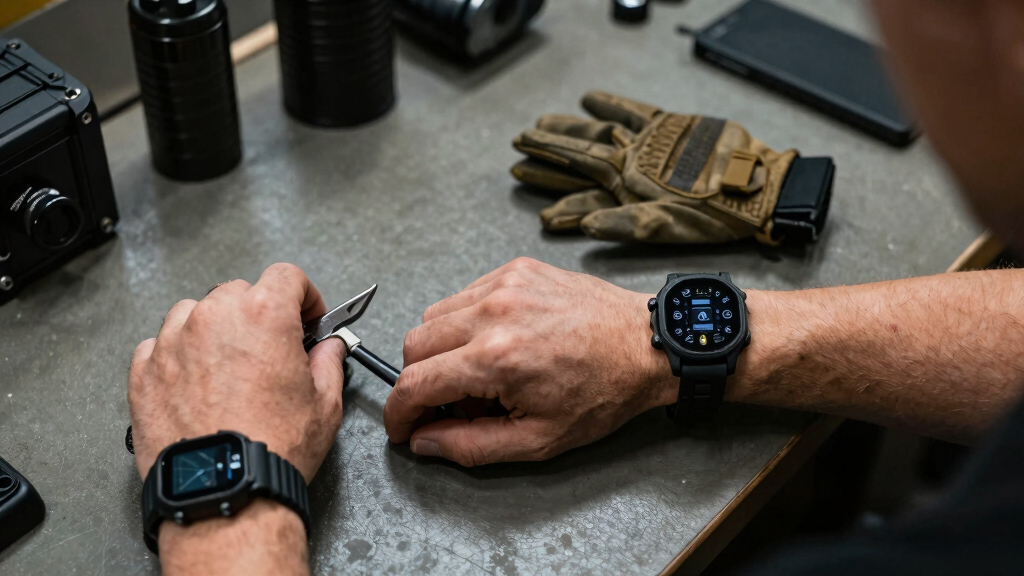
rugged tactical watch for military use
As an affiliate, we earn on qualifying purchases.
As an affiliate, we earn on qualifying purchases.
Navigation & Sensors: Who Keeps You on Track?
Tactical smartwatches shine with multi-band GPS, ABC sensors (altimeter, barometer, compass), and detailed topo maps. They support waypoint projection, dual-grid coordinates, and GPS/GLONASS/Galileo for better signal reception in dense cover. These features enable precise navigation, route planning, and real-time updates, which are invaluable in complex or unfamiliar terrain. For example, a Garmin tactix 8 can show your exact position, suggest optimal routes, and even display night-vision-readable maps, significantly reducing the risk of disorientation.
Traditional watches, however, usually only feature a compass and basic altimeter/barometer. They lack digital maps and satellite connectivity. This limits their navigation capabilities but also means they are immune to signal jamming or failure. When signals are jammed or GPS is unreliable, a simple compass, a good map, and an altimeter become your fallback, providing a fundamental but crucial navigation backup. Think of it as the difference between relying on a smartphone’s GPS and carrying a compass on a lanyard—you can’t always depend on digital tools in the field. The implication is that while smartwatches offer advanced, efficient navigation, traditional watches provide unmatched reliability when electronic signals are compromised, making each suitable for different operational contexts.”
As an affiliate, we earn on qualifying purchases.
Stealth & EMCON: Can You Stay Invisible?
Here’s a clear cut: Smartwatches with radios emit RF signals — Bluetooth, Wi-Fi, LTE — which can give you away. These signals can be detected by electronic surveillance or signal-detection devices, compromising covert operations. Many tactical smartwatches include ‘stealth mode’ that disables wireless transmission, dims displays, and reduces RF emissions. However, even in stealth mode, some residual signals or electromagnetic signatures might still be detectable under certain conditions. Therefore, they are not foolproof for complete concealment.
Traditional watches, on the other hand, emit nothing. They’re silent, EMP-resistant, and leave no electronic signature, making them ideal in environments where concealment is paramount. If your mission demands staying hidden or avoiding detection by electronic means, a simple analog or digital tactical watch remains the most discreet option. The importance of RF emissions in tactical scenarios lies in their potential to reveal your location or activities. Managing these emissions through stealth modes or choosing non-electronic gear is essential for maintaining operational security and minimizing the risk of detection.
stealth tactical watch for covert operations
As an affiliate, we earn on qualifying purchases.
As an affiliate, we earn on qualifying purchases.
Health & Data: Are Smartwatches Worth It?
Smartwatches collect data that can inform your training or recovery, providing insights into heart rate, HRV, sleep patterns, and pulse oximetry. These metrics can help you optimize performance pre-mission, track fatigue, or identify health issues before they escalate. However, in high-stakes environments like combat or rescue missions, these features often become secondary or even distracting. The primary focus is on reliable navigation, communication, and gear durability — aspects that directly impact safety and mission success.
While health data can be valuable during training or planning phases, relying on it during critical operations may be impractical. The data collection and analysis require power and sensor stability, which might be compromised in extreme conditions. Therefore, understanding the practical limitations of health features helps determine whether they are supplementary or unnecessary in the field. Think of health metrics as an added bonus—useful for preparation but not a substitute for proven tactical tools like maps, compasses, and rugged gear.
Cost & Practicality: What’s the Real Investment?
Traditional tactical watches are often cheaper, ranging from ~$50 for basic G-Shocks to $500+ for serious field watches like Marathon or Luminox. They’re built for rugged use and last for years without fuss, making them a cost-effective choice for those prioritizing reliability and minimal maintenance. Their straightforward design reduces the risk of failure and simplifies repairs, which is crucial in remote or high-stakes environments.
Tactical smartwatches usually cost between $350 and $1,100+. High-end models like Garmin tactix or Suunto Traverse Ultra pack advanced features such as multi-satellite navigation, health monitoring, and connectivity. However, they come with a higher price tag, and ongoing costs like charging, software updates, and potential repairs must be considered. Additionally, their complexity can introduce points of failure or maintenance challenges in the field. Your decision should weigh how much you value technological advantages against the need for rugged reliability, ease of use, and operational secrecy. The trade-off centers on upfront investment versus long-term dependability and mission adaptability.
Real-World Use Cases: When to Pick What?
Imagine a military unit in the field. They often wear traditional watches like Luminox or Marathon for their reliability, simplicity, and stealth. No signals, no fuss. These watches serve as a dependable timekeeping tool that requires minimal maintenance and offers instant readability without electronic distractions. Meanwhile, their support team uses smartwatches for real-time navigation, tracking, and data analysis during training or planning, leveraging their advanced features to coordinate complex operations.
In contrast, a rescue diver might prefer a dive-rated tactical smartwatch equipped with GPS and environmental sensors, but still keeps a backup analog watch for critical navigation if electronics fail underwater or in cold conditions where batteries drain faster. The choice depends on matching gear capabilities with environmental demands and operational priorities. Using both types in tandem allows teams to maximize their strengths—relying on traditional watches for core reliability and smartwatches for situational awareness when conditions permit. This approach ensures operational flexibility and resilience across diverse scenarios.
Frequently Asked Questions
Can a tactical smartwatch replace a traditional watch in the field?
Not entirely. While smartwatches provide advanced features, they depend on power and signals. For pure reliability and stealth, a traditional watch remains the backbone of field gear.Are smartwatches allowed during military operations?
It varies. Many units restrict connected devices due to security and OPSEC concerns. Always check your unit’s policies before wearing a smartwatch in active environments.Which lasts longer in extreme cold—smartwatch or quartz watch?
Quartz watches generally handle cold better since electronics can freeze or malfunction. Smartwatches’ batteries and screens are more sensitive to temperature drops, which can impair their operation or cause failure. This means in extreme cold, traditional quartz watches tend to be more dependable, ensuring you keep accurate time without electronic issues disrupting your mission.Smartwatch GPS is highly accurate for most applications, but it’s best used as a backup. In environments with signal jamming or dense cover, relying solely on GPS can be risky. Carrying a compass, map, and altimeter remains essential for critical navigation to ensure you have reliable, fail-safe tools to prevent disorientation or mission failure.
What’s the best way to manage battery life during long missions?
Optimize your smartwatch’s battery by enabling power-saving modes, disabling non-essential sensors, and turning off wireless communications when not needed. Carry spare batteries or portable chargers if possible. However, traditional watches require no power management and will continue to operate reliably without recharging, making them a more dependable choice when power sources are limited or unavailable.Conclusion
Choosing between a tactical smartwatch and a traditional tactical watch isn’t about which is better — it’s about what your mission demands. If you need reliability and stealth, classic gear wins. For tech-savvy navigation and data, smartwatches add value. The smart move? Own both, and deploy them as your mission evolves. Gear that adapts to your needs keeps you one step ahead—every time.Halloween Picks
halloween
As an affiliate, we earn on qualifying purchases.