
TL;DR
Listen free for 30 days with Audible
Thousands of audiobooks and originals — cancel anytime.
Start your free trialAs an affiliate, we earn on qualifying purchases.
Measuring your watch’s lug width precisely ensures a perfect fit for straps and bracelets. Use calipers for accuracy, and double-check measurements before buying. This simple step saves headaches and protects your watch’s look.
Always use a digital caliper for the most accurate lug width measurement—avoid relying on rulers for small measurements.
Measure the inside distance between the lugs, not the outer edges, to get the true strap fit.
Double-check your measurement to account for slight variations, especially on vintage or curved lugs.
Many online resources and conversion charts can help identify non-standard lug widths, saving you guesswork.
Matching the original lug width prevents discomfort, damage, and ensures your watch looks its best.
What Is Lug Width and Why It Matters
Understanding lug width means knowing the distance between the two points where your strap attaches. It’s measured in millimeters and influences how well your strap fits, looks, and feels. If you choose a strap that’s slightly too wide or narrow, it can cause discomfort or even damage the watch case over time. For example, a 20mm lug width on a dive watch ensures a snug, secure fit for your rubber strap, preventing water from seeping in.
Accurate measurement guarantees you get a strap that sits flush, doesn’t slide around, and looks sharp. It’s especially critical when buying aftermarket straps or swapping out vintage pieces where specs aren’t always listed. Choosing the correct lug width also impacts the longevity of your watch and its aesthetic appeal. An ill-fitting strap can cause undue stress on the lugs, potentially leading to cracks or breaks. Conversely, a perfect fit distributes tension evenly, protecting the watch’s integrity and maintaining its sleek appearance.

Digital Caliper, Esydon Upgraded Calipers 6 inch, Measuring Tool, Electronic Ruler, with Large LCD Screen, Auto-Off Feature, Inch and Millimeter Conversion, Plastic Case, Perfect for Household, DIY
- Cost-effective Digital Caliper: Affordable with essential features
- Multiple Measurement Modes: Outside, inside, depth, step
- Wide Measurement Range: 0-6 inches / 0-150 mm
As an affiliate, we earn on qualifying purchases.
As an affiliate, we earn on qualifying purchases.
How to Measure Your Watch Lug Width Step-by-Step
- Remove the strap or bracelet from your watch. It’s easier to measure when the strap isn’t in the way, reducing errors caused by the strap’s thickness or curvature.
- Use a digital caliper—preferably one with a millimeter scale—for best accuracy. If you don’t have one, a ruler can work but is less precise, especially for small measurements. The choice of tool can influence the reliability of your measurement and, consequently, your strap fit.
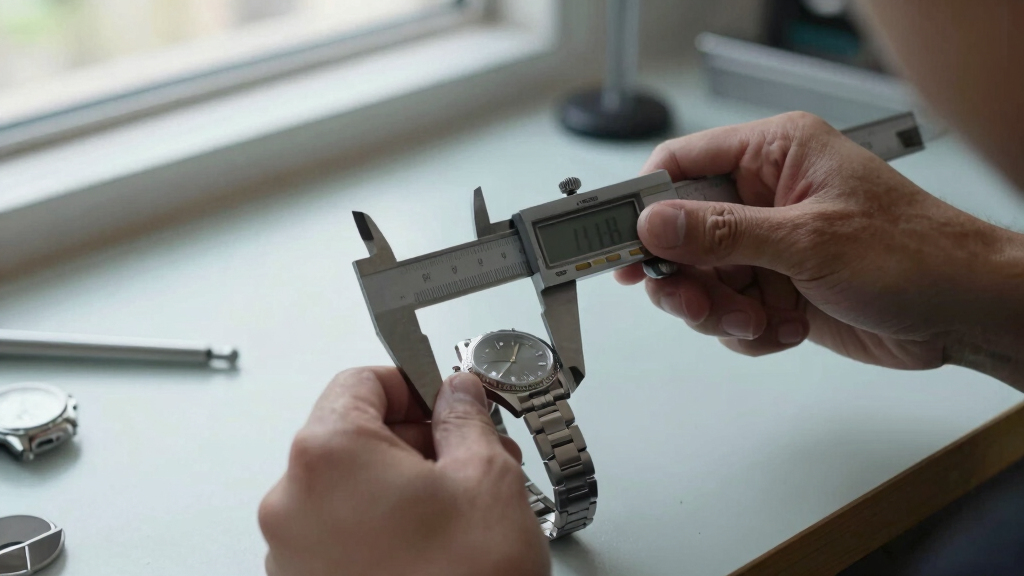
- Align the caliper’s jaws inside the lugs, spanning from the inner edge on one side to the other. Make sure the caliper is straight and not angled, as misalignment can lead to inaccurate readings that cause purchasing mismatched straps.
- Gently close the caliper until it touches the inside edges of the lugs. Don’t squeeze too hard—just enough for a snug fit. Applying too much pressure can distort the measurement, especially on delicate or curved lugs.
- Read the measurement in millimeters. Record it for reference, but remember that slight variations can occur depending on where exactly you measure.
- Double-check by measuring again to confirm accuracy. Slight variations can happen, especially with curved or angled lugs, so verifying ensures you have the correct size before shopping.
If your watch has curved lugs, measure at the point where the strap would sit, not the outer edges, since this provides the most relevant and consistent measurement for strap fitting.

TIESOME 20mm Silicone Watch Bands, Quick Release Waterproof Soft Rubber Replacement Straps with Silver Plated Stainless Steel Buckle Compatible with Smart Watch Sport Watch for Men Women (20mm, Black)
- Compatibility: Fits 20mm spring bar watches
- Easy to Install: Quick-release spring bar for tool-free change
- Premium Material: High-strength silicone with stainless steel buckle
As an affiliate, we earn on qualifying purchases.
As an affiliate, we earn on qualifying purchases.
Common Mistakes That Can Throw Off Your Measurement
- Measuring the outer width of the lugs instead of the inner distance where the strap attaches. Outer measurements can be misleading because they include the lug’s thickness and curvature, which do not reflect the actual space available for the strap.
- Using a ruler or tape measure for small measurements—these tools lack the precision needed and can lead to significant errors, especially in the millimeter range critical for watch straps.
- Not accounting for the lug shape—curved or angled lugs can cause you to measure incorrectly if you only measure in a straight line. Recognizing the shape helps ensure you get an accurate internal measurement.
- Measuring with the strap still attached, which can add extra width and distort the actual measurement. The strap’s thickness and curvature can mislead your reading, resulting in a strap that doesn’t fit properly.
For example, measuring the outer edge might give you 22mm, but the actual internal space could be only 20mm. That’s a difference that can make or break your strap fit and comfort. Precision in measurement is essential to avoid costly mistakes and to ensure your strap fits perfectly without forcing or gaps.

Ewatchparts Watch Band Strap & Lug Measuring Ruler Gauge Compatible with 6mm to 30mm Tool Compatible with Invicta
- Model and Size Verification: Ensure compatibility before purchasing
- Precise Strap Measurement: Measures 6mm to 30mm widths
- Compact and Portable: Dimensions: 125mm x 25mm x 2mm
As an affiliate, we earn on qualifying purchases.
As an affiliate, we earn on qualifying purchases.
Latest Tools and Tricks for Perfect Measurement Accuracy
Today, digital calipers are affordable and easy to use, offering measurements accurate to 0.01mm. These tools help eliminate guesswork and provide confidence in your measurement, which is crucial for ensuring your strap fits perfectly and doesn’t cause stress on the lugs. Some smartphone apps now use the camera to estimate dimensions, but they’re less reliable for small, precise measurements because they depend heavily on lighting, angle, and user calibration. An example: a digital caliper costing around $15 can give you consistent readings for your lug width, even on vintage watches with slightly irregular lugs, ensuring you select the right strap size the first time.
Online resources and conversion charts help when dealing with non-standard sizes or vintage pieces—saving you from guesswork and potential fit issues. If you’re uncertain about a measurement, cross-reference with manufacturer specs or ask in watch forums. Investing in reliable tools and using reputable sources can significantly improve your accuracy and the longevity of your watch and its accessories.

JOREST Watch Spring Bar Tool, Watch Repair Kit to Replace the Watch Strap, Watch Link Removal Tool, With User Manual, 56PCS (16-26mm) Spring Bars
- Variety of Spring Bars: 28 pairs in different sizes
- Durable Material: Made of rust-proof stainless steel
- Multi-Function Tool: Replace watch straps and spring bars
As an affiliate, we earn on qualifying purchases.
As an affiliate, we earn on qualifying purchases.
Quick Guide: How to Measure Lug Width (Summary in 3 Easy Steps)
- Remove the strap or bracelet to expose the lugs fully, ensuring no obstructions that could compromise accuracy.
- Use a digital caliper, place it inside the lugs, and measure the distance between the inner edges. Make sure the caliper is aligned straight across for the most reliable reading.
- Double-check your measurement and note the number in millimeters. Confirming your measurement helps avoid errors, especially with curved or irregular lugs.
FAQs: Your Most Common Questions About Measuring Lug Width
Q1: How do I measure if I don’t have calipers? Use a ruler for rough estimates or compare with a strap size you already know. However, calipers give the best accuracy, especially for small measurements. Without precise tools, your measurements may be off, leading to ill-fitting straps or the need for returns.
Q2: Can I replace my strap with a different width? It’s best to match the original lug width to avoid uncomfortable fit or damage. Going wider or narrower can cause issues—measure first! An ill-fitting strap can cause stress on the lugs, leading to potential damage or discomfort over time.
Q3: Are lug widths the same across brands? No, they vary. Always measure your specific watch, especially with vintage or custom models, where specs aren’t always standardized. Relying on generic sizes can result in poor fit and increased wear.
Q4: What if my watch has curved or angled lugs? Measure the inside distance at the point where the strap would sit, not the outer edges. Ensuring the caliper sits flat and aligned with the lug’s shape provides the most accurate reading and avoids under- or overestimating the size.
Q5: How do I find the lug width for vintage or discontinued watches? Check online forums, vintage watch guides, or measure directly if possible. Many retailers list strap sizes compatible with specific models, but verifying your own measurement is always best for a perfect fit.
Frequently Asked Questions
How do I measure my watch’s lug width if I don’t have calipers?
Use a ruler or compare the strap width you already have. For small measurements, a caliper provides the best precision, but a ruler can give a rough estimate if needed.Can I replace my watch strap with a different width?
It’s safest to match the original lug width. Using a strap that’s too wide or narrow can cause discomfort or risk damaging the case. Always measure first.Are lug widths standardized across brands?
No, each brand and model can have different lug widths. Always measure your specific watch for the best fit, especially with vintage or limited-edition pieces.What if my watch has curved or angled lugs?
Measure at the inside of the lugs where the strap attaches, ensuring the caliper sits flat. This gives the most accurate reading regardless of lug shape.How do I measure a vintage or discontinued watch?
Check online forums, vintage watch guides, or measure directly if you can. Many sellers list compatible strap sizes, or you can ask experts for advice.Conclusion
Knowing your watch’s lug width isn’t just about fitting a strap. It’s about preserving comfort, style, and the watch’s integrity. Take the time to measure accurately—your wrist, and your watch, will thank you. Next time you shop for a strap, imagine the perfect fit: snug, flush, and ready for action.Baby shower & registry season Picks
baby registry must-haves
As an affiliate, we earn on qualifying purchases.