TL;DR

Get your wardrobe favorites delivered free with Prime
- Fast, free delivery on millions of items
- Prime Video, Amazon Music and more included
- Member-only deals all year
The Museum at the Fashion Institute of Technology’s exhibition Doll Dressing explores how dolls have influenced fashion and how fashion has used dolls to represent identity. On view through January 3, 2027, it brings together more than 170 objects spanning the 18th century to today. Curator Colleen Hill says the exhibition challenges narrow assumptions about who dolls represent and what they mean.
The Museum at the Fashion Institute of Technology is examining fashion’s enduring relationship with dolls in Doll Dressing, an exhibition of more than 170 objects that traces the subject from the 18th century to the present. The show, on view through January 3, 2027, considers dolls as toys, design tools and cultural symbols—and challenges the idea that they belong to a narrow group of people or a single ideal of femininity.
Organized by Colleen Hill, MFIT’s senior curator of costume, the exhibition brings together dolls, full-size clothing, accessories, videos, art and ephemera. Its range includes historical fashion dolls, contemporary fashion references and objects that show how miniature dressmaking can connect to larger questions about who is represented in fashion.
One early section, “We Can All Be Dolls,” places a 2022 Laverne Cox Barbie alongside a doll wearing a “Black Dolls Matter” T-shirt and a “Protect the Dolls” shirt by designer Conner Ives, created to benefit Trans Lifeline. It also features photographs of the glass-skin makeup Pat McGrath made for Maison Margiela’s spring 2024 Artisanal show, as well as Mattel’s 2019 Creatable World figures, a gender-inclusive fashion-doll line with mix-and-match clothing and wigs.
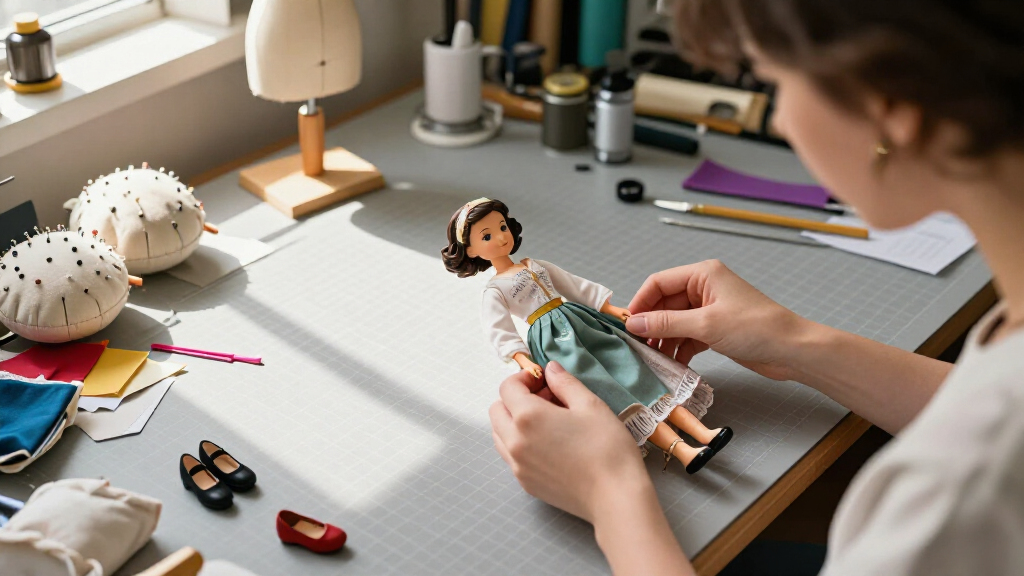
Other displays connect fashion history with the practical work of making clothes. A section called “Modes in Miniature” features designers who worked with dolls or used small-scale forms in their process. Among them are Jeanne Lanvin, who made and sold rag dolls before becoming a couturier, and Madeleine Vionnet, who draped designs on a two-foot mannequin. Designer Jason Wu helped fund his label with earnings from professional doll design, a practice he continues.
Dolls Shape Fashion and Identity
The exhibition’s relevance lies in its account of dolls as more than collectible objects or children’s playthings. Miniature clothing can preserve fashion techniques, help designers test ideas and show how ideas of beauty and gender are circulated. By exhibiting historical dolls alongside contemporary work and references to Black and transgender communities, MFIT presents the doll as a site where questions about representation and belonging have played out.
The show also links childhood play to professional fashion. Hill told Harper’s Bazaar that her own early interest in fashion history began with dolls, a route she says is familiar to many people in the field. The exhibition’s objects give that connection material form: small garments and figures appear alongside full-size designs, revealing how miniature making can be part of a designer’s process rather than simply an influence from childhood.
As an affiliate, we earn on qualifying purchases.
From Miniature Models to Fashion Icons
Dolls and fashion have been connected for centuries, but the exhibition does not treat the porcelain fashion doll as the whole story. Hill said she initially worried an exhibition centered on historical fashion dolls might feel limiting because of their association with 19th-century European and North American porcelain figures. As she researched dolls in 20th- and 21st-century fashion, she found material that broadened the show’s focus across race, age, gender and sexuality.
The displays also connect dolls to fashion imagery beyond the toy itself. Barbie’s wardrobe appears in the exhibition, including the history behind Margot Robbie’s pink gingham outfit in Barbie: The Movie, which recalls a 1964 mail-order dress sold by London boutique Biba. Paper dolls and dollhouse references feature as well, while the show includes work by designers such as Jun Takahashi and Jeremy Scott that draws on the visual language of toys.
That history includes dolls as tools for communicating fashion. The source report describes an 18th-century doll with human hair and notes that fashion dolls served different purposes across earlier centuries. It also points to the postwar Théâtre de la Mode dolls, made by leading French couturiers and toured in Europe and the United States to raise money for survivors of World War II.
““I pretty much exclusively” played with dolls as a kid.”
— Colleen Hill, senior curator of costume at MFIT, speaking to Harper’s Bazaar
As an affiliate, we earn on qualifying purchases.
The Exhibition’s Wider Story
The source report describes selected objects and themes but does not provide a complete account of every section or the full chronology of how dolls’ functions and audiences changed. It is also unclear from the available material how the exhibition’s visitors will respond to its challenge to familiar stereotypes. The display presents examples of broader representation, but it does not claim that the fashion or toy industries have resolved questions of inclusion.
As an affiliate, we earn on qualifying purchases.
On View Through January 2027
Doll Dressing remains on view at the Museum at the Fashion Institute of Technology through January 3, 2027. Visitors can explore the full exhibition to see how its historical dolls, designer collaborations and contemporary references fit together; the source report does not identify any additional announced milestones or programming.
doll display cases for collectibles
As an affiliate, we earn on qualifying purchases.
As an affiliate, we earn on qualifying purchases.
Key Questions
What is Doll Dressing?
Doll Dressing is an exhibition at the Museum at the Fashion Institute of Technology about the relationship between dolls and fashion, from the 18th century to the present.
How long is the exhibition open?
It is on view through January 3, 2027, according to the source report.
What kinds of objects are included?
The exhibition features more than 170 objects, including dolls, full-size garments, accessories, videos, art and ephemera.
How does the show address representation?
It includes objects such as a Laverne Cox Barbie, a Black Dolls Matter T-shirt, a Conner Ives shirt benefiting Trans Lifeline and Mattel’s gender-inclusive Creatable World figures. Curator Colleen Hill said the exhibition’s scope includes race, age, gender and sexuality.
Source: rss
Halloween Picks
halloween
As an affiliate, we earn on qualifying purchases.