
TL;DR
Open a free Amazon Business account
Business pricing, bulk buying and tax-exempt orders.
Create a free accountAs an affiliate, we earn on qualifying purchases.
A wallet that survives daily abuse needs tough materials like full-grain leather or metal, solid construction—like saddle stitching—and smart carry habits. Warranties and recent trends highlight what really lasts over time.
Imagine pulling your wallet from your pocket after a long day — it’s scratched, bent, and maybe even cracked. That’s what daily abuse does. But choosing a wallet built to handle that chaos isn’t about paying more; it’s about understanding what makes some survive while others fail.
In this guide, you’ll learn how materials, construction, and your habits shape a wallet’s lifespan. Whether you’re a first responder, outdoor enthusiast, or just tired of replacing wallets every couple of years, these insights will help you pick something that truly endures.
Prioritize full-grain leather or high-quality metals like titanium for long-lasting durability.
Saddle stitching and reinforced edges are hallmarks of a well-built, durable wallet.
Avoid overstuffing and sitting on your wallet; habits matter as much as materials.
Warranties over 5 years signal confidence in a wallet’s ability to survive daily abuse.
Be cautious with new, untested materials; classic options remain the most reliable.
Field Guide — Everyday Carry Durability
How to Choose a Wallet That Survives Daily Abuse
Scratched, bent, cracked — that’s what daily life does to a weak wallet. But choosing one that endures isn’t about paying more. It’s about understanding materials, construction, and your own habits — the three forces that decide whether a wallet lasts two years or twenty.
80%
Of the durability story
Material choice alone determines roughly four-fifths of how long a wallet survives daily wear.
100 yrs
Longest warranty on record
Saddleback Leather’s century-long guarantee signals total confidence in construction.
1–2 yrs
“Genuine leather” lifespan
The most common label on store shelves hides low-grade splits that crack and peel fast.
80%
Durability decided by material
2
Needles in a saddle stitch
#1
Overstuffing = top seam killer
65y
Trayvax heirloom warranty
∞
Ridge & Filson lifetime cover
Section 01 — Materials
Material Choice Is 80% of the Story
Picking a wallet material is like picking armor — it’s the first line of defense against tears, scratches, moisture, and deformation. These six options cover nearly everything on the market, ranked by proven staying power.
Tier S — Gold Standard
Full-Grain Leather
Keeps the hide’s tough outer layer. Resists tearing, ages into a rich patina instead of cracking. Look for vegetable-tanned or bridle leather — and remember: patina is character, not damage.
Verdict: Buy it for lifeTier A — Bombproof
Titanium & Steel
Nearly indestructible bodies (Ridge, Dango, Trayvax style). Metals don’t crack or warp, but they add weight, can scratch or bend, and strictly limit card capacity.
Verdict: Built for rough useTier A− — Field-Ready
Technical Fabrics
Ballistic nylon, Cordura, X-Pac, and Dyneema deliver high abrasion resistance at minimal weight — favorites in outdoor and EDC circles. Weakness: fraying if cut or punctured.
Verdict: Outdoor workhorseTier B+ — Solid Pick
Top-Grain Leather
Sanded and refinished for a uniform look. Slightly thinner and less tough than full-grain, but still holds up well for years of ordinary carry.
Verdict: Respectable mid-tierUnproven — Untested
Experimental Materials
Cactus “leather,” mushroom-based hides, recycled ocean plastic, carbon fiber. Environmentally interesting, but long-term daily-wear durability remains unverified.
Verdict: Wait for proofTier F — The Trap
“Genuine” & Bonded Leather
“Genuine leather” is a grade label, not a quality claim — it sits near the bottom of the hierarchy and often peels within 1–2 years. Bonded leather (glued scraps) is worse. Avoid entirely.
Verdict: Walk awaySection 02 — The Numbers
Material Durability Index
Relative resistance to tearing, abrasion, moisture, and deformation under daily carry conditions, scored out of 100.
* Newer materials lack long-term, real-world wear data — treat scores as provisional.
Section 03 — Construction
The Details That Separate Survivors From Failures
How a wallet is sewn and finished can matter more than what it’s made of. Construction choice is one of the most crucial durability factors — here’s why.
A saddle-stitched seam can outlast the leather around it.
The key insight of this guide| Factor | Saddle Stitch (Hand-Sewn) | Machine Lockstitch |
|---|---|---|
| Structure | Two needles, one thread pair — balanced, load-distributing seam | Single interlocked thread — fast, uniform, but interdependent |
| One Stitch Breaks | ✓ Seam stays intact — redundancy holds under daily stress | ✗ Seam can unravel from a single snag, cascading into total failure |
| Repairability | ✓ Cobblers can re-stitch by hand | ~ Patch repairs possible, rarely invisible |
| Longevity Signal | ✓ Hallmark of heirloom-grade wallets | ~ Fine for light use; risky for daily abuse |
| Cost Signal | ~ Higher price, but decades of service | ✓ Cheaper to produce — and to replace |
Anatomy of a Wallet Failure — How It Cascades
Overstuffing
Cards force slots beyond designed capacity — the #1 cause of seam failure.
Fibers Stretch
Leather and fabric weaken at stress points: slots, folds, glued seams.
Thread Snaps
Cheap cotton thread rots with sweat and moisture, then breaks under load.
Seam Unzips
A lockstitch unravels from that single break — one snag, total failure.
Wallet Dies
Delamination, torn slots, cracked fold — landfill after 1–2 years.
Section 04 — Habits
Your Carry Habits Can Kill a Wallet Faster Than Materials
Even the toughest wallet falters under bad habits. Small, consistent routines turn a wallet into a long-term companion instead of a disposable item.
✗ The Killers
Back-Pocket Sitting
Bends the wallet at the same spot every day, cracking leather at the fold and stressing seams — and it’s linked to sciatic discomfort.
Overstuffing
The single biggest cause of seam failure. Stretched card slots weaken fibers and permanently deform the wallet’s shape.
Sweat, Moisture & UV
Silent enemies: moisture weakens leather fibers and invites mildew; UV dries leather out, causing fading, brittleness, and premature cracks.
Careless Shoving
Forcing a wallet into tight spaces or harsh conditions imposes forces the materials were never designed to endure.
✓ The Savers
Front-Pocket Carry
Eliminates the sitting bend entirely, reduces physical stress — and as a bonus, cuts pickpocket risk dramatically.
Carry Less
Remove receipts, rarely used cards, and clutter. A minimalist loadout keeps slots within their designed capacity.
Clean & Condition
Regular leather conditioning maintains flexibility and resistance to environmental damage for years.
Use a Cover or Sleeve
A simple wallet cover shields edges and surfaces from abrasion in bags, packs, and crowded pockets.
Section 05 — Warranty as a Signal
What Warranties Reveal About Durability
A long warranty isn’t marketing fluff — it reflects rigorous quality control, superior materials, and construction the maker trusts for decades. Short or absent coverage often means corners were cut.
Coverage length signals confidence. When evaluating a warranty, check what it covers — repair, replacement, or refund — and whether the company’s reputation supports the claim. Anything over five years signals a wallet genuinely built to survive daily abuse.
Section 06 — Trends, Tested
Not Every “Innovation” Survives Daily Abuse
Recent market developments carry a clear lesson: newness and eco-appeal are not durability. Judge materials by real-world testing, not launch hype.
Cautionary Tale — 2023/24
The FineWoven Flop
Apple’s vegan leather replacement scratched and stained almost immediately, and was phased out of iPhone 16 accessories. New materials often prioritize aesthetics or sustainability over proven toughness.
Genuinely Useful
Tracking Goes Mainstream
AirTag-compatible wallets and built-in tracker cards (Chipolo, Tile-style) are now standard. Surviving “abuse” now also means surviving being lost — a real durability win.
Myth Check
MagSafe & Your Cards
Modern EMV chips and contactless cards are unaffected by magnets, and magnetic stripes are fairly resilient. Hotel key cards, however, are genuinely vulnerable — keep them separate.
The Survival Checklist
Five Checks Before You Buy
Material
Full-grain, metal, or ballistic fabric — never “genuine.”
Stitching
Saddle stitch with bonded nylon or polyester thread.
Edges
Burnished or sealed edges — painted edges chip and peel.
Carry
Front pocket, light load, conditioned leather.
Warranty
5+ years of coverage signals confident construction.
Decades
One wallet, carried for life — not replaced every two years.
Why Material Choice Is 80% of Wallet Durability
The key to a wallet that survives daily abuse starts with what it’s made of. Full-grain leather is the gold standard. It resists tearing, ages beautifully, and develops a rich patina, not cracks. Top-grain leather is thinner but still holds up well. Avoid genuine leather labels—those often hide lower-quality splits that crack or peel within 1–2 years.
Metal wallets, like titanium or stainless steel, are nearly indestructible but add weight and limit card capacity. Technical fabrics like ballistic nylon or Dyneema are lightweight, resistant to abrasions, and perfect for outdoor use. Recycled ocean plastics and carbon fiber are newer options, but their long-term durability is still unproven in daily wear scenarios.
Choosing the right material is like picking armor. It’s the first line of defense against tears, scratches, and deformation. The material’s inherent properties determine how it responds to daily impacts, moisture, and wear. For example, leather develops character over time, but if exposed to excessive moisture or rough handling, it can crack or warp. Metals don’t suffer from this but can bend or scratch. Fabrics are lightweight and resistant to scratches but can fray or degrade if cut or punctured.
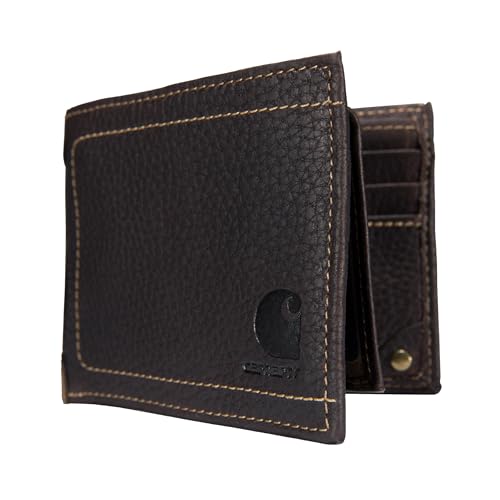
Carhartt Pebble Leather Passcase Wallet Brown
- PEBBLE FULL-GRAIN LEATHER CONSTRUCTION | Crafted from genuine…
- CARRIES UP TO 8 CARDS + CASH |…
- DUAL ID WINDOWS WITH THUMB SLIDES | Two…
As an affiliate, we earn on qualifying purchases.
As an affiliate, we earn on qualifying purchases.
Construction Details That Prevent Wallet Failures
The way your wallet is sewn or assembled can make or break its lifespan. Saddle stitching, sewn with two needles, is the most durable because it creates a balanced, load-distributing seam that resists unraveling when one stitch is compromised. This redundancy ensures that even if a stitch breaks, the overall seam remains intact, which is critical under daily stress. Conversely, machine lockstitch, while faster, tends to unravel if a single stitch fails, leading to larger tears or complete failure. This difference impacts long-term durability because a single weak stitch in lockstitch can cascade into a total breakdown of the wallet’s structure.
Thread quality also plays a pivotal role: bonded nylon or polyester resists rot, abrasion, and moisture, which are common enemies in daily wear. High-quality threads maintain their strength and flexibility over years, preventing seams from fraying or unraveling prematurely. Edge finishing techniques like burnishing or sealing are not just aesthetic choices—they protect against moisture ingress and mechanical damage. Properly finished edges prevent fraying, chipping, and exposure of inner layers, which are often the first points of failure. Recognizing these construction details helps you understand why some wallets last decades while others fail after a few years.
Common failure points such as glued seams, overstretched card slots, or creases at the fold often stem from poor construction choices. Reinforcing these areas with proper stitching, bar tacking, or layered materials distributes stress more evenly, preventing tears or delamination. A well-constructed wallet considers these stress points during design, resulting in a product that resists cracking, tearing, and deformation over years of use.

Mountain Voyage Co Minimalist Wallet for Men & Women – Slim RFID Wallet, Scratch Resistant, Credit Card Holder & Money Clip, Easily Removable Money & Cards, (Gunmetal Titanium)
- Slim and Minimalist Design: Ultra thin wallet for easy carry
- RFID Protection: Blocks unauthorized card scans
- Easy Card Access: Quick slide-in and out cards
As an affiliate, we earn on qualifying purchases.
As an affiliate, we earn on qualifying purchases.
How Your Carry Habits Can Destroy a Wallet Faster Than Materials
Even the toughest wallet can falter if you carry it poorly. Sitting on your wallet in your back pocket repeatedly bends it at the same spot, causing leather to crack at the fold and stressing seams. Overstuffed wallets stretch card slots beyond their designed capacity, weakening fibers and leading to tearing or loss of shape. These habits accelerate material fatigue and compromise structural integrity, often long before the wallet’s materials would naturally wear out.
Moisture from sweat and UV exposure from sunlight are silent enemies. Sweat introduces moisture that can weaken leather fibers and cause mold or mildew, while UV rays break down the fibers and cause fading or brittleness. Excessive exposure to sunlight can cause leather to dry out and crack prematurely. Heavy, careless use—such as shoving the wallet into tight spaces or exposing it to harsh conditions—exacerbates these issues, forcing materials to endure forces they weren’t designed for.
Adopting better habits—like front-pocket carry, using a wallet cover, or removing unnecessary items—reduces stress and prolongs lifespan. Regularly cleaning and conditioning leather also maintains flexibility and resistance to environmental damage. Small, consistent habits reinforce the wallet’s resilience, turning it into a long-term companion rather than a disposable item.

JusBumio Genuine Leather Card Holder Wallet for Men
- Unique Natural Character: Made from full-grain vegetable-tanned leather
- Authentic Natural Marks: Features natural growth marks and scars
- Develops Patina Over Time: Absorbs oils for a vintage look
As an affiliate, we earn on qualifying purchases.
As an affiliate, we earn on qualifying purchases.
What Warranties Reveal About Durability
Brands that stand behind their wallets with long warranties usually build them to last. For example, Saddleback Leather offers a 100-year guarantee, signaling confidence in its durability. The Ridge wallet’s lifetime warranty shows it’s designed for a lifetime of rough use. These warranties aren’t just marketing fluff—they reflect the manufacturer’s confidence in their product’s ability to withstand the rigors of daily life. When a company offers an extended or lifetime warranty, it indicates rigorous quality control, superior materials, and robust construction that can handle wear and tear over decades.
Conversely, brands with short warranties or none at all may cut corners on materials or assembly, risking premature failure. A warranty serves as a practical indicator: it’s a promise that the product can handle real-world conditions, and the longer the coverage, the more reliable the product is likely to be. When evaluating warranties, consider what they cover—repair, replacement, or full refund—and whether the company’s reputation supports their claims. A longer warranty often correlates with higher-quality craftsmanship and more durable materials, making it a valuable factor in your decision.

2026 Apple MFi Certified Wallet Tracker Smart Card for Find My
- Discreet Travel Protection: Ultra-thin, card-style design for concealment
- Apple Find My Integration: Quick pairing with iPhone for real-time tracking
- Easy Item Location: Activate speaker to find lost items
As an affiliate, we earn on qualifying purchases.
As an affiliate, we earn on qualifying purchases.
Latest Trends and What They Mean for Durability
Recent developments show that not all “innovations” survive daily abuse. Apple’s FineWoven fabric, introduced as a vegan alternative, quickly proved susceptible to scratching and staining, leading Apple to phase it out. This highlights a vital lesson: new materials often prioritize aesthetics or environmental benefits over proven durability. When evaluating these trends, it’s essential to consider whether the material has been tested under real-world conditions. Durability isn’t about flashy appearances or eco-claims—it’s about how well a product withstands the rigors of daily life, including impacts, moisture, and wear over time. Relying solely on newness or environmental appeal can lead to disappointing longevity.
Metal wallets, especially minimalist styles, are thriving with heavy competition. They’re nearly indestructible but can scratch or bend if mishandled—reminding us that no material is invulnerable. Tracker integrations, like AirTags, add convenience but introduce potential points of failure, such as losing the device or damaging the wallet during installation. New materials like cactus leather or recycled plastics are promising but still unproven for the demands of rough, daily use. Their durability must be validated through rigorous testing before they can reliably replace traditional options. Ultimately, durability relies on proven performance traits like scratch resistance, deformation resistance, and environmental resilience—not just hype or novelty.
Frequently Asked Questions
What material lasts the longest — leather, metal, or fabric?
Metal wallets like titanium or stainless steel are nearly indestructible, but high-quality full-grain leather can last decades if well cared for. Fabric options like Dyneema are lightweight and resistant to abrasion but may not age as gracefully as leather or metal.Is ‘genuine leather’ actually good?
Not really. ‘Genuine leather’ is a marketing term for lower-quality split leather that cracks or peels within a year or two. Look for full-grain or top-grain leather for better durability.How long should a good wallet last?
A cheap bonded leather wallet might last 1–2 years. A well-made full-grain leather or metal wallet can last 5–20+ years with proper care.Do I really need RFID blocking?
RFID skimming is considered very low risk by security experts. It’s a convenient feature, but not essential for durability or security. Focus on materials and construction first.How do I care for a leather wallet?
Clean it a few times a year with a damp cloth, condition with leather balm twice yearly, and avoid overstuffing or exposing it to excessive moisture or sunlight. Proper maintenance extends its life significantly.Conclusion
Durability isn’t magic — it’s a combination of tough materials, smart construction, and good habits. Pick a wallet designed with resilience in mind, and treat it like the tool it is. Your wallet should be ready for whatever each day throws at it, not another quick replacement.
Remember, a wallet built to last is an investment in reliability. Choose wisely, carry smart, and enjoy years of faithful service from something that’s truly tough.
College move-in / dorm season Picks
dorm essentials
As an affiliate, we earn on qualifying purchases.