
TL;DR

Get your wardrobe favorites delivered free — and shop member deals
- Fast, free delivery on millions of items
- Access to Prime Big Deal Days deals on October 6–7
- Prime Video, Amazon Music and more included
A dive watch rated for 200m is tested under static pressure in labs, not in actual diving conditions. Most recreational divers never go beyond 40m, and extreme depths are achieved only in specialized engineering feats. Your watch’s real limits are shaped by design, maintenance, and the standards it meets.
Imagine your dive watch sitting on your wrist, confidently rated for 200 meters. You might think it allows you to plunge into the ocean and explore every depth without worry. But here’s the truth: those numbers are more about engineering safety margins than real-world limits.
Understanding what a watch’s depth rating really means can save you from costly damage and misplaced confidence. Whether you’re a recreational diver or a gear enthusiast, knowing the science behind the ratings helps you pick the right tool for your adventures—and avoid overestimating what your watch can handle.
Water resistance ratings are based on static lab tests, not real-world conditions.
Most recreational dives stay within 40 meters—well below the rated depths of many watches.
ISO 6425 standards ensure a dive watch meets safety and durability benchmarks beyond just depth rating.
Extreme-depth watches like the Rolex Deepsea Challenge show engineering limits far past human diving depths.
Regular maintenance and proper handling are key to keeping your dive watch functional and safe.
What Does a ‘200m’ Water Resistance Rating Actually Mean?
A ‘200m’ rating sounds impressive, but it’s not a free pass to dive that deep. It’s a lab-tested figure based on static pressure, not the dynamic stresses of swimming or diving. When a watch is rated for 200m, it’s tested in a pressure chamber, with the watch stationary and pressure increased to simulate that depth.
In real life, your arm movements, water currents, and sudden shocks make the actual stress quite different. The rating is a safe margin, designed to keep the watch intact during typical recreational activities like swimming or snorkeling.
For example, a watch marked 200m is built to withstand the pressure at that depth if it were static. But if you twist your wrist sharply or bump the watch against a rock, the seals could fail. That’s why the rating is more about safety margins than actual depth capability.
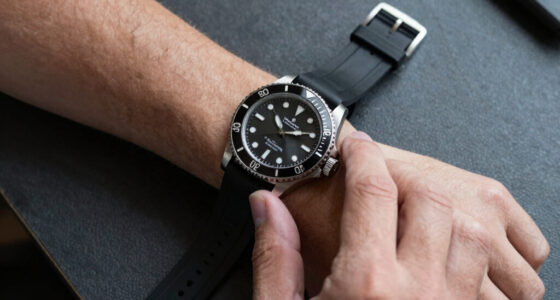
diving watch 200m water resistance
As an affiliate, we earn on qualifying purchases.
As an affiliate, we earn on qualifying purchases.
How Testing Standards Shape the Real Depth Limits of Dive Watches
When dive watches earn their ISO 6425 certification, they undergo rigorous testing beyond just static pressure. They must resist shock, magnetic fields, thermal shocks, and saltwater. The essential standard requires a watch to survive a pressure of 125% of its rated depth, with a minimum of 100m tested at 125m.
For example, a watch rated for 200m must withstand 250m of static pressure during testing, with additional criteria like luminous readability in darkness and resistance to condensation. This comprehensive testing ensures the watch meets strict safety and durability benchmarks, but it doesn’t mean it’s suitable for every deep dive.
Watches rated beyond 200m, like saturation divers’ tools, often feature helium escape valves and are built with special materials to handle extreme conditions, such as the Rolex Sea-Dweller or Omega Seamaster Ultra Deep.
As an affiliate, we earn on qualifying purchases.
How Deep Do Humans Really Dive? The Surprising Limits
Most recreational divers never go deeper than 40 meters, even though their gear might support 100 meters or more. The record for a human scuba dive is around 332 meters, set by Ahmed Gabr in 2014. That’s well beyond typical recreational or even technical diving depths.
Deep saturation dives—used by offshore oil workers—reach about 300 meters, but these are highly engineered environments with specialized equipment and safety measures. Freedivers, on the other hand, push past 120 meters, but without watches being the limiting factor.
Understanding the real limits of human diving helps put watch ratings into perspective. If most humans only dive to 40 meters, then a 200m-rated watch is more than enough for practically all recreational activities. The extreme depths achieved in record-breaking dives or engineering projects show that the limits of human exploration far exceed what even the most capable watches are tested for. This illustrates that the technical specs of a watch are often more about safety margins and engineering prowess than everyday necessity. It emphasizes that for most divers, a watch rated for 200m provides ample safety and reliability, and pushing beyond these depths involves specialized equipment and risks that go far beyond what the watch’s ratings suggest.
As an affiliate, we earn on qualifying purchases.
Extreme Engineering: Watches Made to Survive the Deepest Oceans
Some watches are built to go where no human has gone—at least, unmanned. The Rolex Deepsea Challenge, rated at 11,000m, was designed to withstand pressure over 1,000 atmospheres, tested at nearly 13,750 meters—more than the Challenger Deep.
Similarly, Omega’s Ultra Deep was tested outside the Mariana Trench at 10,925 meters, strapped to the outside of a submersible. These engineering marvels use ultra-strong materials like titanium and thick sapphire crystals, with special seals and helium escape valves.
While these extreme specs grab headlines, they’re not practical for everyday use. Still, they demonstrate that engineering limits are far beyond what most divers or watch owners will ever face, highlighting the incredible advancements in materials and design that allow such feats.
As an affiliate, we earn on qualifying purchases.
Practical Tips for Maintaining Water Resistance and Avoiding Disasters
Water resistance isn’t permanent. Gaskets age, seals degrade, and even the best watches need regular checkups. If you dive or swim often, get your watch pressure-tested annually—especially after battery changes or rough handling.
Always screw down the crown fully before submerging, and avoid pressing buttons underwater unless your watch is rated for it. Rinsing your watch with fresh water after saltwater exposure and avoiding hot water can prevent damage to seals and prolong its lifespan.
For example, a diver who rinses their watch after each saltwater trip and gets it tested annually can significantly reduce the risk of seal failure, ensuring the watch remains reliable and safe during critical moments.
The Future of Dive Watch Ratings: Are They Still Relevant?
As technology advances, dive watches push deeper and get more durable—yet most users don’t need more than 300 meters of water resistance. The trend toward ultra-deep ratings is more marketing than practical necessity for 99% of wearers.
With innovations like ceramic bezels, titanium cases, and better lume, modern dive watches are more reliable and comfortable than ever. But for everyday diving or water activities, a 200m or 300m rated watch is more than enough.
Remember: the real question isn’t how deep your watch can go, but how well it maintains its seals over time and how you care for it.
What You Should Actually Look for in a Dive Watch
Ratings matter, but so do construction quality, materials, and maintenance. A watch rated 200m but with worn seals or a damaged crystal isn’t reliable. Conversely, a well-maintained 100m-rated watch can serve you perfectly in most water situations.
Focus on:
- ISO 6425 compliance
- Well-sealed crowns and casebacks
- Material durability (ceramic, titanium)
- Regular maintenance schedule
- Ease of use and readability
Frequently Asked Questions
Can I swim or shower with my 50m water resistant watch?
Most 50m rated watches are suitable for splashes and brief immersion, like washing hands or rain. But they’re not designed for swimming or showering. Always check the crown; if it’s not screw-down, water could seep in during more active water use.
Why did my ‘waterproof’ watch fog up or flood?
Fogging often results from condensation, usually caused by a failed seal, a damaged gasket, or temperature changes. Flooding happens when seals are old or the crown was left unscrewed. Regular pressure testing and maintenance prevent these issues.
Is a 200m rating overkill for recreational diving at 30m?
Yes, for most recreational divers, a 200m-rated watch is more than enough. Ratings are safety margins; actual depths rarely approach these limits. Focus instead on proper maintenance and compliance with ISO standards.
Do I need a helium escape valve?
Helium escape valves are only necessary for saturation divers living in heliox environments for extended periods. For typical recreational or technical diving, they’re unnecessary and often just a style feature.
Can a dive watch survive the Mariana Trench?
Yes, specially engineered watches like the Omega Ultra Deep and Rolex Deepsea Challenge have been tested beyond Challenger Deep’s 11,000 meters. These are prototypes or experimental models, not everyday wearers.
Conclusion
Your dive watch’s rated depth is more a safety margin than a literal limit. It’s built to withstand pressure in controlled tests, not in every dive scenario. Think of it as a sturdy tool—more than enough for your adventures, if cared for properly.
When you choose a dive watch, focus on real-world needs and maintenance rather than headline-grabbing depths. With the right care, your watch can serve reliably for years, no matter how deep you go—whether that’s 10 meters in a pool or the ocean’s abyss.
Fall Picks
fall essentials
As an affiliate, we earn on qualifying purchases.